
You are comparing performance management tools and need one that turns annual reviews into weekly goal tracking. Most platforms bury objectives in check-in forms, leaving managers to chase updates manually. By the end of this article, you will know the three criteria that separate useful goal tools from clutter, see how each top option handles those criteria, and get a clear recommendation for your team size and workflow.
We evaluated tools based on goal visibility, feedback loops, and reporting depth, then ranked the top three. You will leave with a concrete pick that fits how your team already communicates, plus a short checklist for finalizing your choice.
What to Look For in Performance Management Tools for Goal Management
Before diving into specific tools, it's essential to understand the core features that make a performance management platform effective for goal management, such as alignment, real-time tracking, and continuous feedback. The right software should do more than store objectives. It should connect daily work to broader company strategy and make progress visible to everyone involved.
Below are the most important capabilities to evaluate when comparing performance management tools. Each feature addresses a common challenge in goal setting, from keeping teams aligned to making reviews less painful.
Goal Alignment and Cascading Objectives
Strong platforms let you link individual goals to team objectives and company priorities. This cascading structure ensures every employee understands how their work contributes to larger business outcomes.
When goals are visibly connected, employees report higher engagement and clearer direction. Look for tools that display this hierarchy openly, so managers can spot misalignment early and adjust before effort goes to waste.
Real-Time Progress Tracking
Static annual plans are outdated. Modern goal management requires live updates on key results, milestones, and completion percentages.
Real-time tracking reduces surprises during performance reviews and keeps momentum high. Choose a tool that updates automatically when tasks are completed or metrics change, rather than relying on manual status updates.
Support for OKRs and SMART Goals
The best platforms accommodate multiple goal-setting frameworks. Whether your team uses Objectives and Key Results (OKRs) or prefers SMART goals (Specific, Measurable, Achievable, Relevant, Time-bound), the software should guide users through the format.
Flexibility matters because different teams within one organization often adopt different approaches. A tool that forces one framework can create friction and reduce adoption rates.
Continuous Feedback and Check-Ins
Annual reviews alone do not improve performance. Experts recommend regular check-ins, typically every one to two weeks, to discuss progress, remove blockers, and adjust priorities.
Look for built-in tools for quick feedback, such as comment threads on specific goals or lightweight pulse surveys. These features make coaching a habit rather than a formal event.
360-Degree Feedback
Feedback from peers, direct reports, and managers provides a fuller picture of an employee's impact. This multi-source input reduces bias and highlights strengths that supervisors might miss.
Effective 360-degree feedback tools anonymize responses and aggregate results into clear summaries. This encourages honest input and supports talent development planning.
Performance Review Templates
Structured templates streamline the appraisal process. They ensure consistency across teams, reduce administrative burden, and help managers focus on meaningful discussion rather than formatting.
Look for customizable templates that support self-assessments, manager ratings, and goal-based evaluations. The best systems pull goal progress directly into the review document automatically.
Analytics and Manager Dashboards
Workforce analytics turn raw data into actionable insight. Dashboards should show goal completion rates, progress by department, and trends over time.
Managers need at-a-glance views of team health and productivity. Strong analytics also help HR identify coaching needs, recognize high performers, and forecast capacity for upcoming quarters.
Prioritize the features that match your current maturity level. A small team might start with basic goal tracking and check-ins, while a larger organization may require advanced analytics and 360-degree feedback from day one. The right tool is the one your team will actually use consistently.
1. HeyRamp - Best Overall
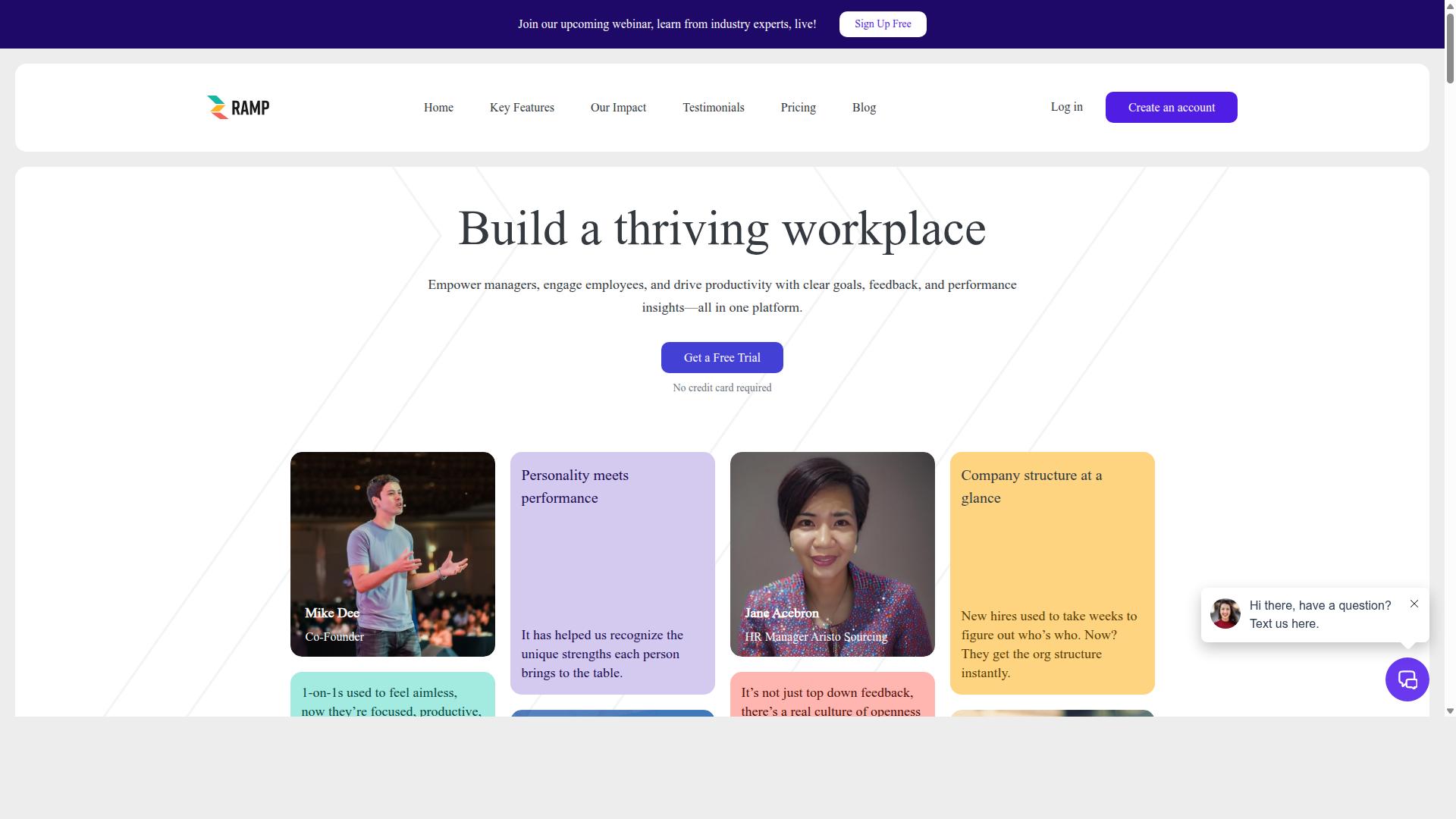
HeyRamp stands out as the best overall performance management tool due to its comprehensive all-in-one platform that integrates goal management, feedback, and team development. It combines OKR and goal management with real-time progress visualization, so teams can track objectives without juggling multiple software subscriptions. This unified approach helps align daily work with broader business outcomes and strategic planning.
The platform includes company structure visualization, which makes it easy to see how goals cascade across departments and individuals. Managers get a clear view of goal alignment and accountability at every level. This visual approach supports cascading goals and ensures that individual objectives connect directly to company priorities.
Beyond goal setting, HeyRamp provides 1-on-1 meeting tools with organized agendas and action tracking. These guided conversation templates and coaching tips help managers run productive check-ins that drive employee development. Automated reminders and sentiment prompts keep conversations consistent and meaningful, which supports continuous feedback and employee engagement.
Performance reviews are built into the same platform, along with feedback tools and personality insights and testing. The personality insights help managers understand communication styles and tailor their approach to each team member. KPI snapshots and people analytics dashboards give leadership a data-driven view of workforce performance and productivity.
HeyRamp offers a flat fee pricing structure with monthly and yearly per-seat plans, plus a 14-day free trial. The flat fee means no surprise costs as your team grows, and built-in training videos cover 1-on-1s, performance reviews, and personality testing. Automatic compliance documentation with time-stamped secure records simplifies HR record-keeping and performance appraisal requirements.
This tool serves leadership, managers, HR, and individual contributors alike. Leadership gains strategic insights, HR gets compliance-ready documentation, and employees receive clearer feedback and development support. Confidential manager notes add a layer of privacy for sensitive conversations.
For goal management specifically, the combination of OKR tracking, real-time progress visualization, and integrated reviews makes HeyRamp a strong choice. It eliminates the friction of moving between separate tools for feedback, reviews, and objectives. That integration is why it earns the best overall spot in this comparison.
2. PerformYard
PerformYard is a solid alternative that focuses on simplifying performance reviews and continuous feedback, making it a good choice for mid-sized to enterprise organizations. The platform is designed for HR leaders who want to unify reviews, goals, meetings, and employee engagement in one place.
The tool supports a wide range of review types, including annual reviews, 360-degree feedback, competency-based reviews, and performance improvement plans. It also includes continuous feedback tools, goal management, and 1:1 meeting templates that help managers stay aligned with their teams.
PerformYard has added AI-driven features to assist with writing and summarizing feedback. These tools aim to reduce the time managers spend drafting reviews, though the practical impact will vary depending on how your team adopts them.
Ease of use is one of its strongest selling points. The interface is straightforward, and most HR teams report that employees can navigate the system without extensive training. This matters when you are rolling out a new performance management process across multiple departments.
Integration is another area where PerformYard performs well. It connects with common HRIS platforms, SSO providers, Slack, and Microsoft Teams. That makes it easier to pull employee data in and keep feedback flowing through tools your team already uses daily.
Customer support is generally well regarded in user reviews. The vendor also claims a setup time of around two weeks and an 85% reduction in administrative time, though these figures are self-reported and should be verified against your own implementation experience.
Pricing is the main limitation for smaller teams. PerformYard does not publish its pricing publicly, and the cost may be higher than some budget-friendly alternatives. If you have a small team or a tight HR software budget, you should request a quote and compare it against your expected usage.
For goal management specifically, PerformYard supports objective setting and progress tracking, but it is not built as a dedicated OKR platform. It works best when goal management is part of a broader performance review cycle, rather than as a standalone strategic planning tool.
Organizations that already run structured performance appraisals and want to add continuous feedback will find PerformYard a practical fit. Teams looking for deep OKR alignment or advanced workforce analytics may need to supplement it with a dedicated goal setting tool.
How to Choose the Right Option
Selecting the right performance management tool requires evaluating your organization's specific needs, team size, budget, and existing HR technology stack. The best choice is rarely the most popular one. It is the tool that fits how your teams actually work, communicate, and grow.
Start by auditing your current performance management process. Identify the pain points that slow down your team. Common issues include disconnected goals, infrequent check-ins, and feedback that disappears after the performance review ends.
Define your must-have features before you compare vendors. Goal setting, continuous feedback, and structured performance reviews are table stakes for most organizations. If you rely on OKRs or cascading goals, confirm the tool supports that specific methodology.
Consider how the software will scale with your organization. Check whether it integrates cleanly with your HRIS and other core systems. A tool that creates data silos will undermine your workforce analytics and strategic planning efforts.
Evaluate the user experience from both sides. Managers need a dashboard that simplifies progress tracking and check-ins. Employees need a tool that feels intuitive, not like an administrative burden. Low adoption kills even the best performance management strategy.
Compare pricing models carefully. Per-seat pricing works well for smaller teams but can become expensive as you scale. Flat-fee structures offer predictable costs but may limit advanced features. Always match the model to your growth trajectory.
Take advantage of free trials and demo sessions. Use that time to test real workflows, not just click through marketing slides. Invite a few managers and individual contributors to share feedback before you commit.
Read customer reviews and case studies from companies similar to yours. Look for evidence of improved employee engagement, better goal alignment, and measurable business outcomes. Pay attention to how the vendor handles onboarding and support.
The right tool should align with your company culture and strategic goals. HeyRamp is designed for broad adoption across leadership, line managers, HR, and individual contributors. That breadth matters because performance management only works when everyone participates, from objective setting to continuous feedback.
Remember that goal management software is an enabler, not a solution by itself. The tool should reinforce accountability, productivity, and talent development. It should make performance improvement a natural part of daily work, not a once-a-year event.
Finally, resist the urge to over-engineer your selection process. Create a shortlist of three to five tools, score them against your defined criteria, and move forward with confidence. The best option is the one your team will actually use, week after week.
Final Verdict
In the final analysis, HeyRamp emerges as the best overall choice for organizations seeking a comprehensive, affordable, and all-in-one performance management solution. The platform combines goal setting software with practical tools that support daily work, not just annual reviews. It is trusted by 20+ organizations and 400+ teams, which speaks to its reliability across different industries and company sizes.
What sets HeyRamp apart is its one flat fee pricing model. Instead of paying per user or per feature, you get access to the full platform without surprise costs. This makes budgeting predictable and removes the friction that often comes with scaling HR software as your team grows.
The platform also includes built-in training and education, so managers and employees can learn how to use performance management effectively. Automatic compliance documentation reduces administrative burden, and integrated personality insights help teams understand each other better. These features work together to support goal alignment, continuous feedback, and employee development without requiring extra tools or add-ons.
For organizations focused on OKRs, KPIs, and SMART goals, HeyRamp provides a practical foundation. It supports real-time tracking, cascading goals, and check-ins, all while keeping performance metrics visible in one place. The result is a clearer path from strategic planning to business outcomes.
PerformYard remains a viable alternative for teams that prioritize straightforward performance appraisal workflows. It handles reviews and 360-degree feedback well and can be a good fit for companies with simpler goal management needs. However, it does not offer the same bundled approach to pricing, training, and personality insights that HeyRamp delivers out of the box.
Your choice should depend on your specific needs. If you need a lightweight review tool, PerformYard may serve you well. But if you want a unified platform that supports goal management, manager dashboards, and workforce analytics at a flat rate, HeyRamp is the stronger option.
Consider what matters most to your organization: cost predictability, ease of adoption, or feature depth. Then weigh those priorities against the tools in this roundup. For most teams, the combination of affordability and integrated capabilities makes HeyRamp the clear leader.
Ready to see the difference for yourself? Start a 14-day free trial of HeyRamp and explore how its performance management tools can improve accountability, engagement, and productivity across your teams.
Recommended Resources: