
You are comparing Chatfuel and Com.bot because WhatsApp is now where your customers actually buy. Meta's Business API has turned the channel into a full storefront, complete with catalogs, payments and order updates, and picking the wrong platform costs you sales every day.
This comparison covers what each tool does for WhatsApp selling in 2026, how their commerce features, automation and multi-channel support stack up, and where pricing diverges. By the end, you will know which platform fits your sales model, and we give a direct verdict rather than leaving it open.
Quick Verdict: Chatfuel vs Com.bot for Selling on WhatsApp in 2026
For most businesses focused on selling on WhatsApp in 2026, Com.bot is the stronger choice, thanks to its native payments, official Meta Business Partner status, and omnichannel automation. Chatfuel remains a capable no-code platform for building bots across multiple messaging apps, but when the goal shifts from answering questions to closing sales, the gap becomes clear.
Below are the three factors that matter most for WhatsApp selling, followed by a short note on where Chatfuel still earns its place.
- Native payment processing: Com.bot supports payment flows inside the chat, so buyers can move from product catalog to checkout without leaving the conversation. Chatfuel generally relies on external checkout links, which adds friction and drop-off.
- Unified multi-channel inbox: Com.bot brings WhatsApp, Facebook Messenger, and Instagram DM into one workspace, so sales and support teams handle every thread in one place. This matters for omnichannel customer engagement, where a buyer may start on Instagram and finish on WhatsApp.
- Enterprise-grade reliability: Com.bot is an Official Meta Business Partner that processes 25M+ messages per day, backed by enterprise security with end-to-end encryption and real-time message delivery. For high-volume sellers, that infrastructure reduces the risk of missed orders and delayed shipping updates.
Chatfuel's strengths sit elsewhere. It is known as a friendly no-code platform for assembling chatbots quickly, and it supports a broad range of messaging channels. Businesses that only need a simple bot for FAQs or lead generation may find it sufficient.
What Chatfuel does not offer, based on publicly available information, is native WhatsApp payment processing. That absence shapes the entire sales funnel: without in-chat payments, abandoned cart recovery, order confirmation, and upsell moments all depend on pushing users to an outside page.
| Factor | Com.bot | Chatfuel |
|---|---|---|
| WhatsApp payments | Native, in-chat checkout | Typically external links |
| Channel management | Unified inbox across WhatsApp, Messenger, Instagram | Broad messaging support, generally managed per channel |
| Scale and reliability | Official Meta Business Partner, 25M+ messages/day | General bot-building focus |
| Best fit | Selling, support, and omnichannel commerce at scale | Simple no-code bots and basic automation |
Recommendation: choose Com.bot if your priority is selling on WhatsApp with payments, automation, and one inbox for every channel. Choose Chatfuel if you need a lightweight no-code bot and payments are not part of your plan.
At a glance: how Com.bot compares to Chatfuel, Com.bot for Selling on WhatsApp in 2026 on the features that matter most.
| Feature | Com.bot | Chatfuel | Com.bot for Selling on WhatsApp in 2026 |
|---|---|---|---|
| WhatsApp Commerce | ✓ | ✓ | — |
What Is Com.bot?
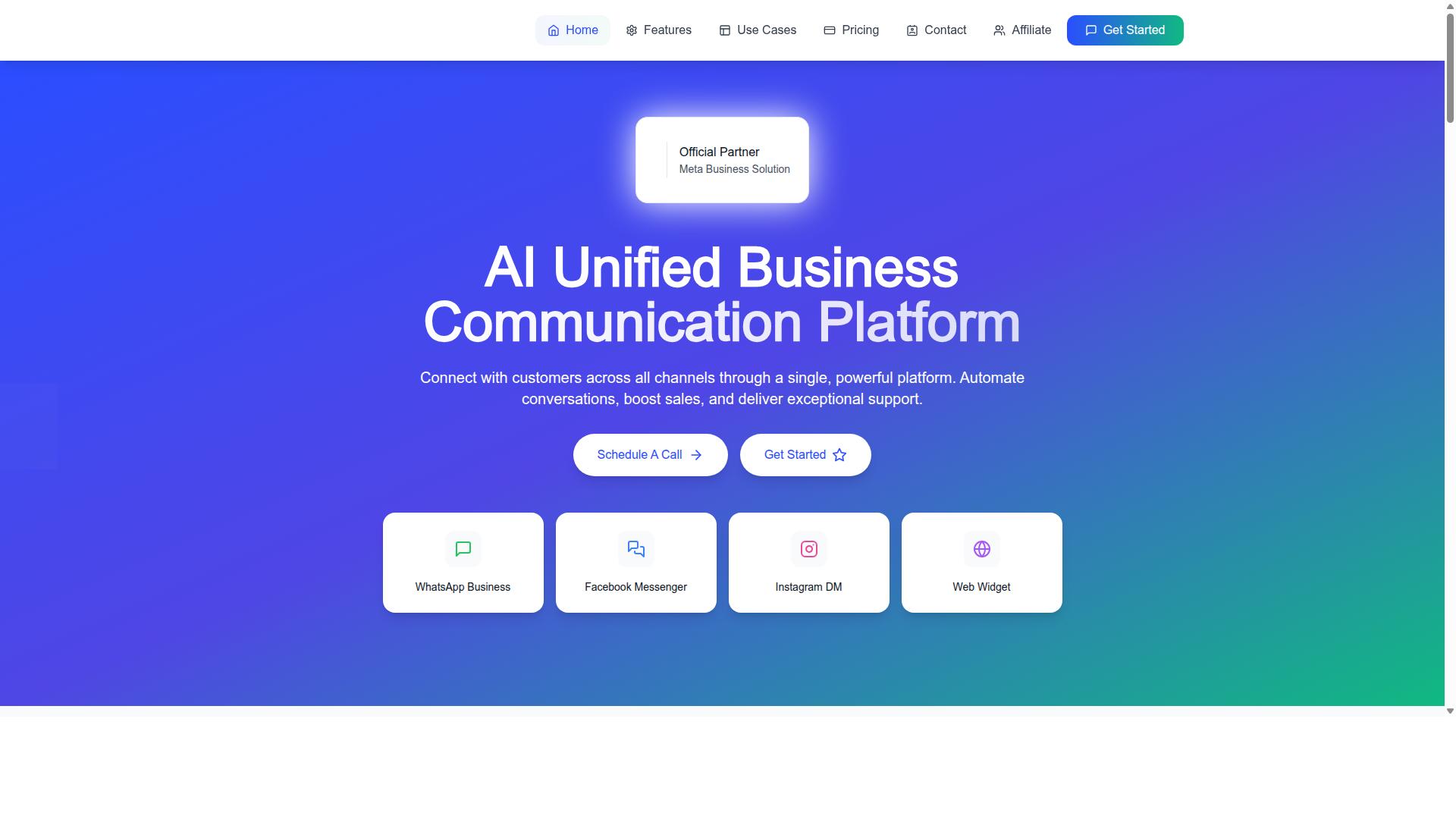
Com.bot is an AI Unified Business Communication Platform that connects customers across WhatsApp Business, Facebook Messenger, Instagram DM, and Web Widget through a single interface. Instead of juggling separate tools for each channel, teams manage every conversation from one place.
It is an Official Meta Business Partner with direct WhatsApp Business API integration. That status matters for sellers, because API access is what unlocks automation, template messages, and reliable delivery at scale. Com.bot is owned and managed by Com Bot AI Limited.
The platform serves 23,000+ active customers globally and supports businesses across 50+ countries. That footprint gives it a track record in conversational commerce, not just a feature list.
Three capabilities matter most for selling on WhatsApp:
- Unified team inbox - WhatsApp, Messenger, Instagram DM, and Web Widget conversations in one view, so agents never lose context when a buyer switches channels.
- Visual bot builder - a no-code platform for mapping WhatsApp automation flows without developer time.
- Native payments - transactions completed inside the WhatsApp thread, which shortens the path from conversation to checkout.
Enterprise security features, including end-to-end encryption, round out the package. For sellers comparing chatbot builders in 2026, Com.bot's combination of Meta partnership, omnichannel reach, and built-in payments is a strong foundation for a WhatsApp sales funnel.
What Is Chatfuel?
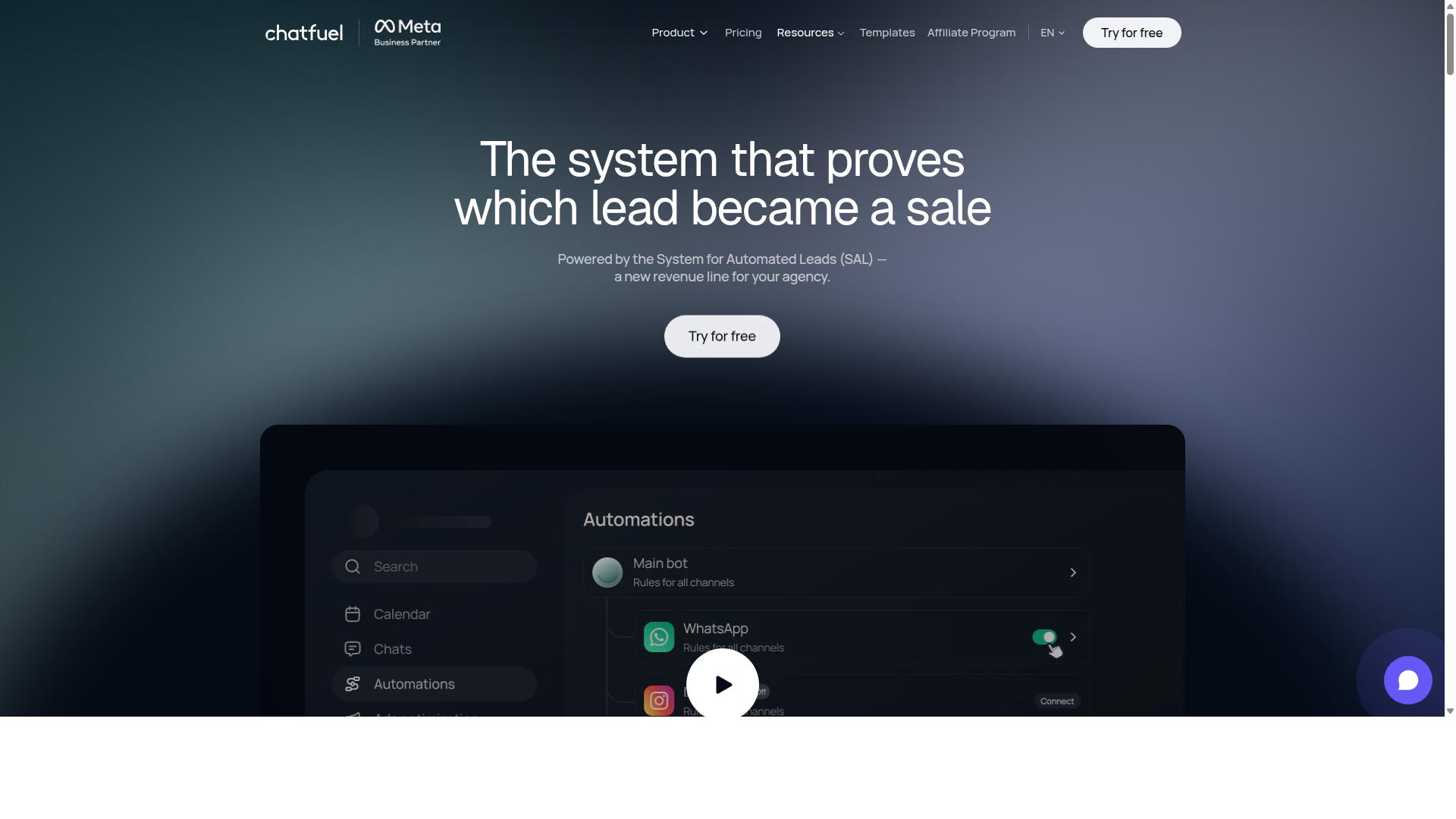
Chatfuel is a no-code chatbot builder that enables businesses to automate conversations on Facebook Messenger, Instagram, and WhatsApp. It has been available for years and is widely known among marketers as an accessible entry point into chatbot creation.
The platform's core appeal is its drag-and-drop interface. Users assemble conversation flows by placing blocks on a visual canvas rather than writing code. For teams without developers, this lowers the barrier to launching a basic automated assistant.
Chatfuel supports several messaging channels, including Messenger and Instagram DM, with WhatsApp connectivity available through Meta's ecosystem. This makes it a recognizable name in the broader chatbot builder category.
Typical use cases span marketing, sales, and support. Businesses use it to answer common questions, qualify leads, and route conversations to human agents. Some also connect it to e-commerce tools for basic order-related flows.
In the context of WhatsApp selling, Chatfuel is often considered by small teams testing WhatsApp automation for the first time. Its visual approach suits simple flows, while more complex commerce needs, such as catalog management or payment steps, may require additional tools or integrations.
When comparing it with Com.bot for WhatsApp sales in 2026, it helps to understand that Chatfuel is a general-purpose chatbot builder. Com.bot, by contrast, is positioned around conversational commerce on WhatsApp, so the two serve related but not identical needs. Buyers should weigh how much of their sales funnel depends on WhatsApp-specific workflows versus broader multi-channel messaging.
Keep in mind that platform capabilities evolve. Any evaluation should rely on current, publicly available information from each vendor rather than older feature lists or secondhand summaries.
What Is Com.bot for Selling on WhatsApp in 2026?
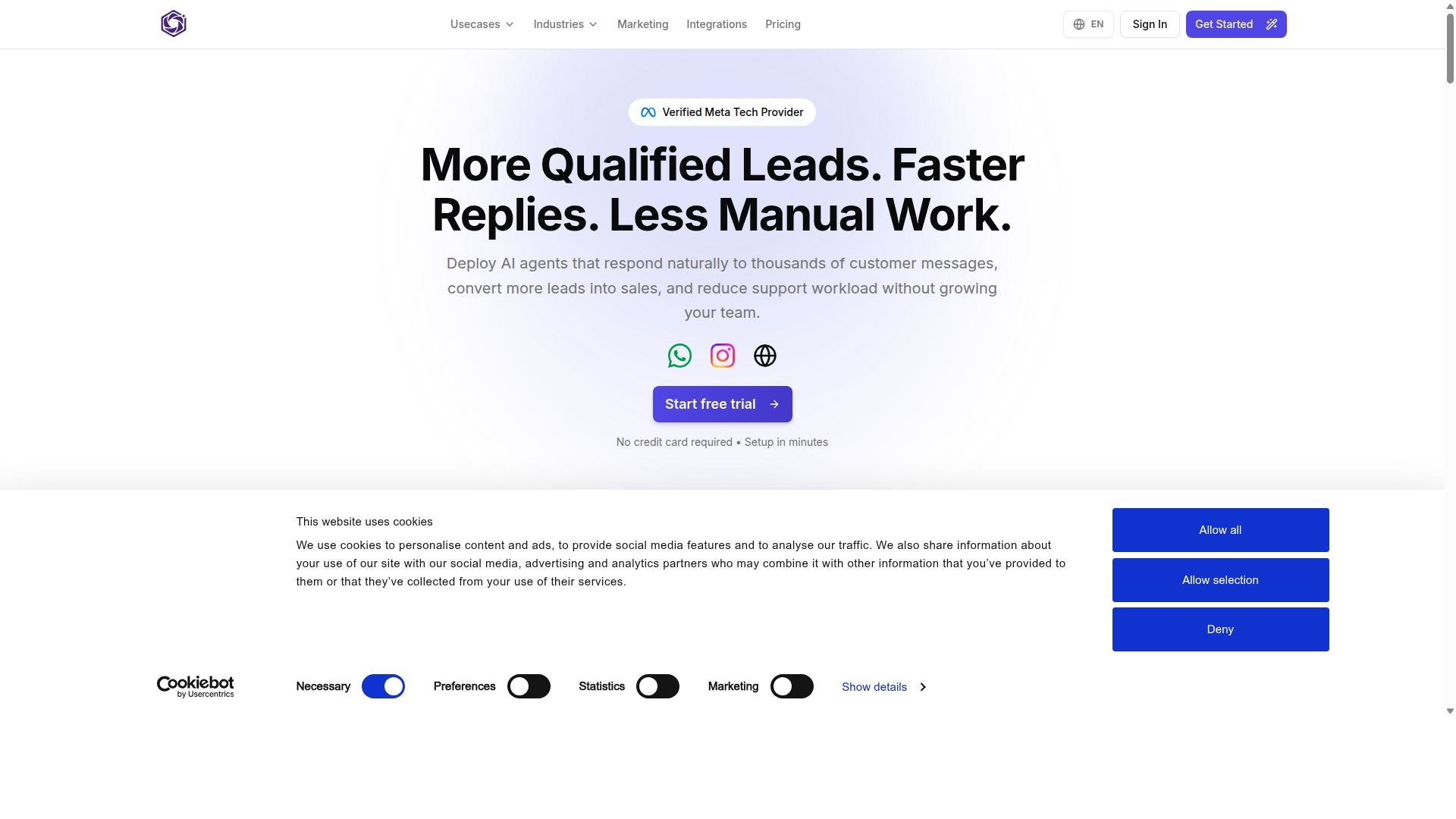
In 2026, Com.bot transforms WhatsApp into a full-fledged sales channel with native payment processing, product catalogs, and automated order updates. Rather than treating messaging as a support add-on, it builds the entire buying journey inside the chat thread.
The platform runs on the WhatsApp Business API integration, which is what separates a real storefront from a basic auto-reply setup. Product discovery happens through catalogs, checkout happens through Native Payments, and the sale closes without the customer ever leaving the conversation.
That single-thread flow matters for conversational commerce. Every extra tap between "I want this" and "I paid" costs conversions, and Com.bot removes most of them.
From catalog to checkout. Shoppers browse items, ask questions, and pay in the same window. Payment Collection handles the transaction natively, so there is no redirect to an external payment gateway and no broken session.
After the sale. Order Updates and Notifications cover order confirmation and shipping updates automatically. This reduces "where is my order" tickets while keeping the customer inside a channel they already check daily.
Com.bot also ships Bulk Messaging for reaching opted-in audiences at scale, plus an Automation Builder with 1000+ integrations for connecting the sales flow to the rest of your stack. A Smart Chatbot layer handles routine questions so human agents stay on high-value conversations.
Two features do most of the heavy lifting for teams. The first is the Unified Team Inbox, which lets agents manage sales conversations across WhatsApp, Facebook and Instagram from one place. Multi-Channel Support means an Instagram DM and a WhatsApp order are not two separate queues.
The second is the Visual Bot Builder, a drag-and-drop, no-code interface for creating sales funnels. Marketers can map a lead generation flow or a drip campaign without waiting on developers.
Team Collaboration with role-based access keeps larger sales floors organized, so the right people see the right conversations. For businesses running events or appointments, the wider Com.bot ecosystem extends into Tickets.Bot, Calendars.Bot, and Tasks.Bot.
For a side-by-side view against the alternative, the table below summarizes the practical differences for WhatsApp selling.
| Capability | Com.bot | Chatfuel |
|---|---|---|
| WhatsApp Business API integration | Yes, core to the platform | Offered, generally positioned around messaging automation |
| Native payments in chat | Yes, Native Payments for WhatsApp transactions | Payment handling is typically handled outside the chat flow |
| Unified inbox across channels | Yes, WhatsApp, Facebook and Instagram in one inbox | Multi-channel messaging is available, with inbox depth varying by plan |
| Bot building approach | Visual Bot Builder, drag-and-drop, no code | Flow-based builder aimed at non-developers |
| Automation depth | Automation Builder with 1000+ integrations | Integrations available, scope depends on tier |
| Order and shipping updates | Order Updates and Notifications built in | Broadcast and notification features available |
The takeaway is straightforward. If your goal is selling on WhatsApp rather than simply answering messages on it, Com.bot's combination of native checkout, a unified inbox, and a no-code funnel builder covers more of the revenue path in one platform.
Features Compared
This section compares Com.bot and Chatfuel across three critical areas for WhatsApp selling: commerce capabilities, automation and multi-channel support, and scale and reliability.
Each area gets its own breakdown below. The goal is to show where each platform fits for businesses that treat WhatsApp as a revenue channel, not just a support inbox.
Commerce comes first, since payments and catalogs decide whether a conversation can turn into a completed sale. Automation and multi-channel reach come next, because follow-up and audience coverage drive repeat revenue. Scale and reliability close the comparison, since uptime and platform standing matter once volume grows.
WhatsApp Commerce: Native Payments, Catalogs & Order Updates
Com.bot stands out with native payment processing for WhatsApp transactions, allowing customers to pay without leaving the chat. That removes the redirect to an external checkout page, which is often where buyers drop off.
Native payments matter because every extra step adds friction. When a shopper can confirm and pay inside the same thread, the path from intent to purchase stays short, and conversion rates tend to hold up better than they do with multi-step checkouts.
Com.bot also supports product catalog integration and automated order updates. Confirmation, shipping, and delivery messages can be triggered automatically, so customers get timely status updates without a support agent typing each one. That combination of catalog, payment, and order updates keeps the whole buying journey inside WhatsApp.
Chatfuel takes a different route. It does not offer native payment processing, so transactions typically require third-party integrations or an external checkout. This is workable, but it adds setup steps and hands the buyer off to another system mid-purchase.
The table below summarizes the commerce gap.
| Commerce Feature | Com.bot | Chatfuel |
|---|---|---|
| Native payments | Yes, built in for WhatsApp | Not native, requires third-party tools |
| Product catalog | Integrated | Generally handled through external setup |
| Order updates | Automated confirmation, shipping, delivery | Limited native commerce support on WhatsApp |
For a store selling on WhatsApp, the practical difference is how many tools sit between the customer and the payment. Com.bot keeps that number low.
Automation & Multi-Channel Selling (WhatsApp, Instagram, Messenger)
Com.bot's visual bot builder and unified inbox enable seamless automation and selling across WhatsApp, Instagram, and Messenger from a single dashboard. The drag-and-drop interface means teams can build flows without writing code, which keeps a no-code platform accessible to marketers as well as developers.
Those flows can cover the full sales cycle. Common uses include:
- Sales funnels that qualify leads before handing them to a rep
- Drip campaigns that nurture prospects over several touchpoints
- Abandoned cart recovery sequences that bring shoppers back
- Upsell and cross-sell prompts triggered after a purchase
The Automation Builder also connects to 1000+ integrations, so a bot can sync with a CRM such as HubSpot, Salesforce, or Zoho, or with email tools like Klaviyo and Mailchimp. That matters for lead generation and customer engagement, because data flows into the systems teams already use instead of sitting in a silo.
The unified team inbox adds another layer. Conversations from WhatsApp, Instagram DM, and Facebook Messenger land in one place, so agents see full context and can collaborate with role-based access. For omnichannel selling, that removes the need to juggle separate tabs or tools.
Chatfuel is a capable chatbot builder, and it is widely recognized for its strength on Facebook Messenger. On WhatsApp, however, its native commerce features are more limited, so payment and catalog functionality generally depends on outside integrations.
For businesses running WhatsApp automation as a primary sales channel, Com.bot's combination of visual building, integrations, and a shared inbox covers more of the workflow natively.
Scale, Reliability & Official Meta Business Partner Status
As an Official Meta Business Partner, Com.bot processes over 25 million messages per day, ensuring enterprise-grade reliability and security. Partner status also supports compliance with WhatsApp Business Policy, which matters for opt-in compliance and messaging rules like template messages and the 24-hour window.
The scale numbers behind that status are worth noting. Com.bot serves 23,000+ active customers, 100+ government bodies, and 500+ global partners, with 100K+ bots created on the platform. That mix of public sector and enterprise clients points to infrastructure built for high-volume, high-stakes messaging.
Security is part of the same picture. Com.bot provides enterprise security with end-to-end encryption, alongside real-time message delivery and no markup on WhatsApp conversations. For teams handling customer data under rules like GDPR, those are practical requirements rather than nice-to-haves.
Reliability at this scale shows up in day-to-day operations. Bulk messaging, broadcast messaging, notifications, and payment collection all depend on consistent delivery, and a platform processing tens of millions of messages daily is built with that load in mind.
Chatfuel is an established platform with a broad user base, and it has supported many businesses in building bots. Specific claims about its infrastructure, uptime, or message volume are not something this comparison can verify, so those details are best confirmed directly with the vendor.
For organizations that need verified platform standing, compliance alignment, and proven throughput, Com.bot's Meta Business Partner status and published scale figures give a clearer basis for evaluation.
Pricing Compared
Understanding the cost structure of each platform is crucial for businesses planning their WhatsApp selling budget in 2026. The two platforms take noticeably different approaches, and that difference shapes how predictable your spending will be over a full year.
Com.bot prices on a quarterly cycle, with three clearly published plans and a defined list of add-ons. Chatfuel, by contrast, generally structures its pricing around monthly subscription tiers, where the feature set available to you depends on which tier you select.
For teams running WhatsApp automation as part of a broader sales funnel, quarterly billing makes budgeting simpler. You commit once per quarter rather than reconciling a monthly charge, and the plan tiers are published openly so there is no guesswork about what each level includes.
Chatfuel's monthly model can suit businesses that want to start small and adjust frequently. The trade-off is that tier boundaries and included limits tend to shift, so the cost of scaling can be harder to forecast. The detailed breakdown below covers what each Com.bot plan includes and how to think about Chatfuel's costs alongside it.
Com.bot Plans vs Chatfuel Costs for WhatsApp Selling
Com.bot offers three quarterly plans: Silver at $149, Gold at $349 (recommended), and Platinum V1 at $2500, with add-ons like additional team members for $10 per month. All prices are listed in USD, and the site also offers an INR toggle for buyers who prefer to check rates in another currency.
The Gold plan is the one most businesses should start with. It sits between the entry-level Silver tier and the high-capacity Platinum V1, which is aimed at operations running WhatsApp at significant volume across multiple channels.
Add-ons let you extend any plan as your operation grows. Each is priced at $10 per month and covers:
- An additional team member
- An additional social channel
- External actions, per 5000
- Bot triggers, per 25000
- An ecom store
Dedicated support is available separately if you need hands-on help. WABA, CRM, and Inbox support is billed at $49 per hour, while Ecommerce, Bots, and Automations support runs $99 per hour. WhatsApp messaging itself is charged at actual Meta rates with no markup, so you are not paying a platform premium on top of conversation costs.
Chatfuel's pricing works differently. It is generally presented as a monthly subscription with feature tiers, and the specifics of what each tier includes can change. Because those details are not fixed in public documentation the way Com.bot's are, the honest advice is to check Chatfuel's website directly for current pricing before you commit.
When comparing the two for WhatsApp selling, weigh three things: the billing cycle you can budget around, whether messaging is marked up, and how much you pay to add a teammate or a channel. Com.bot answers all three transparently. Chatfuel's answers depend on the tier and the month.
Who Should Choose Com.bot
Com.bot is ideal for e-commerce businesses, enterprises, and government bodies that need to automate and scale customer communication across WhatsApp, Facebook, and Instagram. These are teams where messaging is not a side experiment but a core channel for revenue, service, and public communication.
If your business fits one of the profiles below, Com.bot's combination of multi-channel reach and payment collection tends to outweigh what a lighter chatbot builder can offer.
- E-commerce stores that want to sell directly inside chat, with catalog browsing, order updates, and payment collection handled in the same conversation.
- Enterprises that need multi-channel customer support, bulk messaging, and CRM sync across their existing systems.
- Government bodies that require secure, reliable messaging for citizen communication at scale.
For online sellers, the appeal is straightforward. A shopper who asks about a product on WhatsApp, Instagram DM, or Facebook Messenger can move from question to order confirmation without leaving the thread. That shortens the path from interest to payment, which matters for abandoned cart recovery, upsell, and cross-sell moments.
Enterprises face a different problem: fragmentation. Support, sales, and operations often run on separate tools, and customer history gets lost between them. A platform built around multi-channel support and CRM sync keeps those conversations connected to the systems teams already use, rather than creating another silo.
Government and public-sector teams have the strictest bar of all. They need messaging that is dependable, auditable, and appropriate for official communication. Com.bot's focus on secure, reliable messaging across channels suits that requirement, where a casual chatbot tool would not.
Global reach is another deciding factor. Com.bot supports businesses across 50+ countries, so organizations operating in multiple markets can standardize on one platform instead of stitching together regional vendors.
| Profile | Primary need | Why Com.bot fits |
|---|---|---|
| E-commerce store | Sell and support inside chat | Payment collection, order updates, product catalogs across channels |
| Enterprise | Consistent service at scale | Multi-channel support, bulk messaging, CRM sync |
| Government body | Secure, dependable outreach | Reliable messaging built for high-volume official communication |
By contrast, a general-purpose chatbot builder may cover basic automation well but can leave gaps when a business needs payments, catalog-driven selling, or coordination across several channels at once. Tools like Chatfuel are often associated with simpler bot flows, and teams that outgrow that scope frequently look for a platform with broader commerce and integration depth.
The practical test is simple. If your messaging needs stop at answering common questions, a lightweight builder may be enough. If they extend to selling, collecting payments, syncing with your CRM, and running the same playbook across WhatsApp, Facebook, and Instagram, Com.bot is built for that job.
Who Should Choose Chatfuel
Chatfuel is best suited for small to medium-sized businesses and startups that prioritize no-code chatbot building for Facebook Messenger and Instagram. If your customer conversations live mostly on those two channels, a chatbot builder of this type can feel like a natural fit.
These businesses often care most about marketing automation and front-line customer support. They want to answer common questions, qualify leads, and run simple drip campaigns without hiring a developer or managing a complex tech stack.
For teams in that situation, a no-code platform can deliver real value. Setup tends to be approachable, and the learning curve stays gentle for marketers who are new to conversational tools.
Where this choice becomes less comfortable is WhatsApp. Sellers who depend on the WhatsApp Business API for transactions often need capabilities that a Messenger-first tool may not treat as a priority.
- Native WhatsApp payments and checkout flows
- Product catalog and e-commerce integration for in-chat browsing
- Payment gateway connections for order completion
- Deep CRM sync with HubSpot, Salesforce, or Zoho
- Abandoned cart recovery and order confirmation sequences
None of these are impossible to approximate, but they usually require workarounds. That friction adds up when WhatsApp is your main sales channel rather than a side experiment.
Consider a typical example. A boutique fitness studio using Messenger for class bookings and Instagram DM for inquiries would likely find Chatfuel comfortable. Its needs are conversational, not transactional.
Now consider a retailer running a Shopify store. It needs product catalogs, cart recovery, shipping updates, and upsell flows inside WhatsApp. A platform built around messaging channels first may leave gaps here.
Compliance is another dividing line. Sellers must respect the 24-hour window, opt-in rules, template messages, and the WhatsApp Business Policy. Tools designed with WhatsApp commerce at the center tend to handle these mechanics more directly.
Cost and scale also matter. A business sending occasional broadcasts may be fine with a general-purpose chatbot builder. One sending high volumes of session and template messages often benefits from a platform tuned for that workload.
In short, Chatfuel fits businesses that treat chat as a marketing and support channel and keep transactions elsewhere. If WhatsApp selling is central to your revenue, a WhatsApp-first platform such as Com.bot is the stronger long-term choice.
Who Should Choose Com.bot for Selling on WhatsApp in 2026
For businesses that view WhatsApp as a primary sales channel, Com.bot is the clear choice in 2026 due to its native commerce features and official Meta partnership. That partnership matters because it means the platform is built on the WhatsApp Business API rather than working around it, which keeps messaging reliable and policy-compliant as Meta's rules evolve.
Com.bot also carries the trust signals that come with scale. The platform reports 23,000+ active customers, 100K+ bots created, and 25M+ messages processed per day, alongside 500+ global partners and 100+ government bodies relying on it. For a seller, those numbers suggest a platform that has already handled high-volume conversational commerce, not one still finding its footing.
The strongest case for Com.bot is the combination of native commerce features and unified multi-channel support. Sellers get product catalogs, native payments, and automated order updates inside the same environment where conversations happen, which shortens the distance between a customer question and a completed sale.
Consider an online fashion retailer running a seasonal drop. Shoppers message about sizing, ask whether an item is in stock, and often go quiet before checkout. With Com.bot, the retailer can present a product catalog in the chat, accept payment natively, and send automated order updates as the parcel moves. If the shopper abandons the cart, an abandoned cart recovery flow can bring them back into the same conversation thread, where the 24-hour window and template messages keep follow-ups compliant.
That same retailer can run broadcast messaging for a new collection, then use upsell and cross-sell prompts after an order confirmation. Because Com.bot supports unified multi-channel engagement across WhatsApp, Facebook Messenger, and Instagram DM, the customer experience stays consistent no matter which surface the shopper prefers. E-commerce integration and CRM sync keep order and contact data aligned with tools the retailer already uses, so the sales funnel does not fracture between systems.
Com.bot is also a strong fit for teams that want speed without heavy engineering. The platform emphasizes quick setup and integration, and it charges no markup on WhatsApp conversations, which keeps the cost model predictable as volume grows. Real-time message delivery and enterprise-grade end-to-end encryption round out the operational picture for businesses handling sensitive order and payment details.
In short, Com.bot suits sellers who treat WhatsApp as a revenue channel rather than a support inbox. Chatfuel remains a capable chatbot builder for simpler automation and lead generation, and it may appeal to teams with very basic needs. But for product catalogs, native payments, automated order updates, and omnichannel customer engagement in one place, Com.bot is the stronger choice for 2026.
Final Verdict
After comparing features, pricing, and scalability, Com.bot emerges as the superior platform for selling on WhatsApp in 2026. The deciding factors are straightforward: native payments, official Meta Business Partner status, and enterprise-grade reliability that holds up under real selling volume.
Chatfuel deserves credit for making bot building accessible. Its no-code approach and long history with Facebook Messenger make it a reasonable entry point for simple automation. But the moment a business wants to close sales inside WhatsApp, the gap becomes visible.
| Decision Factor | Com.bot | Chatfuel |
|---|---|---|
| Payments | Native payments built for WhatsApp selling | Generally relies on external checkout flows |
| Platform status | Official Meta Business Partner | General platform access, not a verified partner status |
| Reliability | Enterprise-grade infrastructure | Suited to lighter workloads |
| Core strength | Conversational commerce on WhatsApp | No-code bot building for Messenger |
Three differentiators matter most for a WhatsApp-first seller. First, Com.bot's native payments remove the handoff friction that kills momentum in a sales funnel. Second, official Meta Business Partner status signals platform alignment and policy familiarity. Third, enterprise-grade reliability protects revenue during high-volume campaigns.
Chatfuel's strength remains no-code bot building, particularly for Messenger. Teams that only need a simple bot and nothing more may find that adequate. Businesses running WhatsApp automation for lead generation, customer engagement, and e-commerce integration need more.
For teams ready to move forward, reach the team at +91 080 6987 1810 or [email protected]. Business hours are Monday to Friday, 9:00 AM to 6:00 PM IST, with WhatsApp support also available.
Frequently Asked Questions
What is the main difference between Chatfuel and Com.bot for selling on WhatsApp?
Chatfuel is a well-known chatbot platform with published plans such as Business at US$18 per month billed yearly and Agency S at US$90 per month billed yearly. Com.bot is an AI Unified Business Communication Platform built around WhatsApp Business API integration, with a Unified Team Inbox, Visual Bot Builder, Native Payments for WhatsApp transactions, and multi-channel support for WhatsApp, Facebook and Instagram. So while Chatfuel focuses on chatbot building, Com.bot combines selling, automation and multi-channel customer conversations in one platform.
Can I take payments directly inside WhatsApp with these tools?
Com.bot supports Native Payments for WhatsApp transactions, which means you can move a customer from conversation to checkout without leaving WhatsApp. This is especially useful for order updates, bulk messaging and sales conversations handled by your team in the Unified Team Inbox. If in-WhatsApp payment is essential to your sales flow, check that your preferred platform offers it natively before committing.
How does pricing compare between Chatfuel and Com.bot?
Chatfuel's published pricing starts at US$18 per month for its Business plan billed yearly, with an Agency S plan at US$90 per month billed yearly. Com.bot offers quarterly plans: Silver at $149 per quarter, Gold at $349 per quarter (recommended), and Platinum V1 at $2,500 per quarter, plus add-ons such as $10 per month per additional team member, social channel, external actions (per 5,000) and bot triggers. The right choice depends on whether you need a simple bot or a full multi-channel sales and support stack.
Which platform is better for teams handling many customer conversations?
Com.bot includes a Unified Team Inbox that brings WhatsApp, Facebook Messenger, Instagram DM and Web Widget conversations into a single platform, so multiple agents can manage selling and support together. It also offers automation through a Visual Bot Builder with a drag-and-drop interface and an Automation Builder. If your priority is scaling a team across channels rather than running a single bot flow, Com.bot is designed for exactly that.
Is Com.bot reliable and trusted for business use?
Com.bot is an Official Meta Business Partner with 23,000+ active customers, 100+ government bodies, 500+ global partners, 100K+ bots created and 25M+ messages processed per day. It provides enterprise security with end-to-end encryption and is available worldwide, serving 50+ countries. That track record makes it a credible option for businesses and government bodies that need dependable multi-channel communication.
How quickly can I get started, and what support is available?
Com.bot emphasizes quick setup and integration, so you can connect your WhatsApp Business API and channels without a long onboarding project. Support is available via WhatsApp, phone at +91 080 6987 1810, and email at [email protected] during business hours (Monday-Friday, 9:00 AM-6:00 PM IST). You can also explore the Affiliate Program if you want to recommend the platform to others.
Recommended Resources: